Architecture
Lumina is a modular Rust workspace. Each crate has one job, and the renderer is backend-agnostic behind a single trait. (Why it's shaped this way is a separate document: DESIGN.md.)
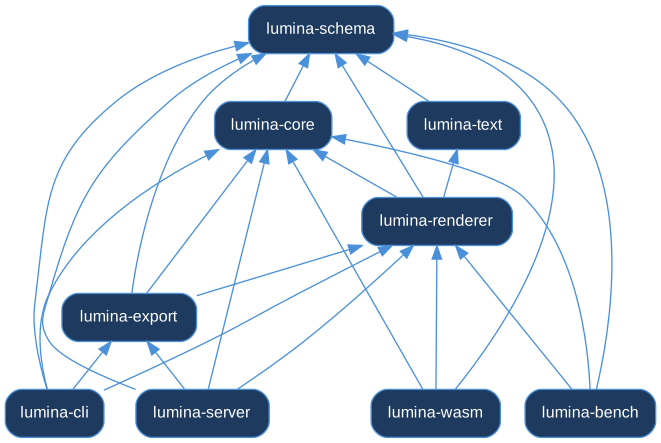
Generated from cargo metadata by docs/architecture/gen-diagrams.sh —
these are the real dependency edges, not an illustration.
lumina/
├── crates/
│   ├── lumina-schema/    LSF types + JSON Schema generation (schemars)
│   ├── lumina-core/      Scene graph, timeline evaluator, easings, LAB interp, event bus
│   ├── lumina-renderer/  Renderer trait → SkiaRenderer (CPU) + VelloRenderer (GPU)
│   ├── lumina-text/      Fontdue TTF rasterization + per-character font fallback
│   ├── lumina-export/    PNG sequence + MP4/WebM/GIF (FFmpeg stdin pipe)
│   ├── lumina-server/    Axum HTTP: /render /validate /patch /scene_patch /schema /objects
│   ├── lumina-wasm/      wasm-bindgen: render_frame, hit_test, process_event
│   └── lumina-bench/     Criterion benchmarks
├── sdks/{javascript,python}/
└── tools/lumina-cli/
Data flow
LSF JSON
  → Schema validator (structured errors with fix_suggestion)
  → Scene graph + timeline (keyframe evaluation, easing, LAB color)
  → Renderer (Skia CPU  | Vello GPU)
  → Export (PNG sequence | FFmpeg → MP4)   or   WASM canvas


The event flow (host input → hit-test → event bus → playback outcome) is diagrammed in Events & Interactivity:

The Renderer trait
A backend implements render_frame, load_font, and optionally load_image /
set_time. The Exporter<R: Renderer> and the WASM engine are generic over it,
so adding a backend never touches the scene/timeline code. set_time is what
lets time-dependent assets (animated GIFs) and the particle simulator pick the
right state per frame.
Backend parity status
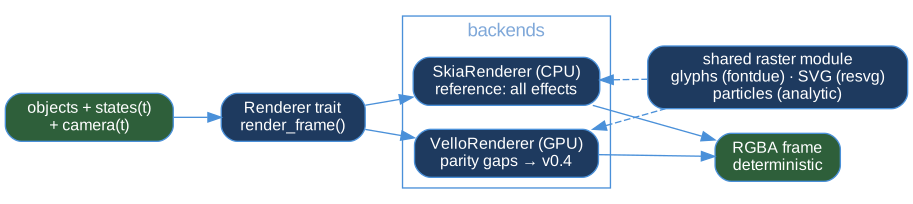
Skia (CPU) is the reference backend with full feature coverage. Vello
(GPU/wgpu, headless) reached object-type parity in v0.3.0 — text, LaTeX,
MathML, images, SVG and particles render on the GPU via a shared
rasterization module. Since v0.4, everything that decides what to draw —
parsing, geometry, ordering, transform math — lives once in the renderer's
common/ module and is consumed by both backends, and parity is enforced
by a cross-backend pixel-diff suite
(crates/lumina-renderer/tests/backend_parity.rs) that renders every
fixture scene on both backends in CI:
| Feature | Skia (CPU) | Vello (GPU) |
|---|---|---|
| All 17 object types | ✅ | ✅ |
| Text / LaTeX / MathML / Image / SVG / Particles | ✅ | ✅ (shared rasterizer) |
| Linear & radial gradients (fill and stroke) | ✅ | ✅ (shared geometry) |
Rounded rectangles (rx/ry) | ✅ | ✅ (shared geometry) |
draw_fraction stroke reveal | ✅ | ✅ (shared dash pattern) |
| Drop shadows / glow | ✅ | ✅ (shared blur pipeline) |
Explicit dash arrays on Line | ❌ | ❌ (schema field not yet implemented, TD-19) |
Every feature row is exercised by the parity suite; scenes render the same on either backend within the suite's tolerances (text carries a slightly wider budget until its two layout paths are unified, TD-18).
Key design choices
- Declarative first — scenes are data; nothing for an LLM to mis-sequence.
- State, not types, drives rendering — the timeline serializes each object's
properties to JSON and rebuilds a per-frame
statemap; new#[serde(default)]fields flow to the renderer with no core changes. - Deterministic — identical inputs yield identical pixels (including particles).